
By hafid / April 5, 2025
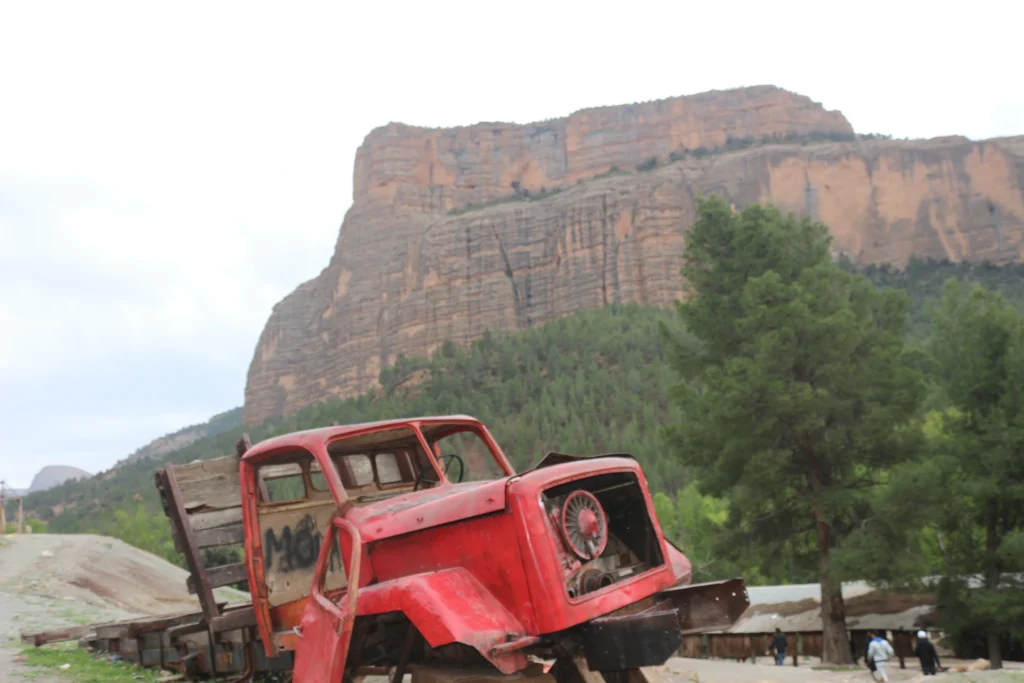
I still remember the first time I saw Cathédrale Imsfrane rising majestically above the landscape. Standing at the edge of the Assif-n-ou-Ahansal River, I was completely awestruck by this natural wonder in Morocco’s High Atlas Mountains. The enormous rock formation, with its towering walls of golden-brown stone stretching 600 meters long and reaching up to 1,872 meters above sea level, truly deserves its cathedral nickname.
Today, I want to share my experiences exploring this hidden gem in central Morocco, a place where breathtaking geology, rich biodiversity, and authentic Berber culture come together to create an unforgettable destination that still flies under the radar of mass tourism.
Cathédrale Imsfrane is nestled in the heart of the Central High Atlas Mountains within the Tamga Biosphere Reserve. It’s situated near the village of Tilouguit and Zawiat Ahançal, alongside the Oued Ahançal river.
Getting here requires some effort, but believe me, the journey is worth it. Here are the distances from major cities:
Most of the main roads are paved, but once you’re in the region, expect some sections of dirt road. From Tilouguit village, you’ll need to travel about 15 km of unpaved road to reach the Cathedral.
If you’re not comfortable driving, shared taxis operate between Zawiat Ahançal and Ouaouizagth, passing by the Cathedral and Tilouguit. The journey takes about 1.5-2 hours.
As someone with an appreciation for geology, I found the story behind Cathédrale Imsfrane fascinating. This isn’t just a pretty rock—it’s a stunning example of millions of years of Earth’s forces at work.
The Imsfrane rock formation stands more than 300 meters above the Assif-n-ou-Ahansal river. What makes it special is its composition—layers of conglomerate rock and sandstone that formed from the erosion of the Atlas Mountains. These sediments were carried by ancient rivers during the Miocene-Pliocene period (between 2 and 10 million years ago).
Later, these deposits were dramatically pushed upward to their current altitude during the Atlas mountain-building process (what geologists call orogenesis). Over time, wind and water sculpted the rock into the cathedral-like shape we see today.
The spectacular contrast between the brown rocks, the green Aleppo pines, and the red earth creates a visual feast that photographers will love. Trust me—bring extra memory cards for your camera!
During my stay, I discovered numerous hiking trails around Cathédrale Imsfrane with varying degrees of difficulty and distance. My favorite was climbing to the summit of the Cathedral itself. The panoramic views from the top are simply spectacular—you can see across the valleys and mountains in all directions.
Other excellent hiking options include:
The best seasons for hiking are summer, spring, and autumn. If you’re not an experienced mountain hiker, I strongly recommend hiring a local guide who knows the terrain. The last thing you want is to get lost in these remote mountains!
If you’re visiting between March and May, don’t miss the chance to go rafting on the Assif-n-ou-Ahansal River. This is one of Morocco’s premier rafting destinations, offering trips ranging from 2-hour excursions to full-day adventures.
The rafting season depends on water levels, which are affected by rainfall, snowmelt, and temperatures. Anyone 14 years and older can participate, making it a great family activity.
For more information about rafting options, check out the Regional Tourism Council website at www.visitbenimellal.com.
Another way I explored the area was by mountain bike. The diverse terrain around Cathédrale Imsfrane offers moderate-difficulty circuits that can take half a day or a full day to complete.
You can ride through traditional villages, pine forests, nomad plateaus, and high pastures. Guides are available to accompany you, and bikes can be rented locally through Atlasaurus Tour Cooperative (+212668125717 or +212678177466).
Beyond nature activities, I enjoyed immersing myself in local culture through:
One of my favorite discoveries was Tilouguit village, a charming traditional settlement with Berber houses arranged on different levels of the mountain slope. The name “Tilouguit” means “bridge” in Berber.
Local legend says the village got its name from a bridge built by a couple who lived in a cave near the pastures to cross the river. Today, it’s a small community with about 9,600 inhabitants at an altitude of 1,226 meters.
Within a short distance of Cathédrale Imsfrane, I explored several fascinating historical sites:
The Cathédrale Imsfrane sits within the Tamga Biosphere Reserve, which is in the process of being registered as a UNESCO Biosphere Reserve. This protected area features exceptional landscapes, numerous cliffs, and escarpments offering extraordinary viewpoints.
The flora consists mainly of beautiful pine forests mixed with red juniper, thuya, and holm oak. I was amazed by the Aleppo pine ecosystem, which creates a distinct environment.
The wildlife is equally remarkable, with many endemic, rare, and threatened species, including 77 bird species and 17 mammal species.
The Assif-n-ou-Ahansal and Oued Melloul rivers form a Ramsar site—a wetland of international importance. This is one of the last wild and near-natural mountain river ecosystems in North Africa.
It protects at least two endemic or threatened species: the Atlas barbel fish (Luciobarbus ksibi) and the Barbary macaque (Macaca sylvanus). The site also hosts wintering birds like the meadow pipit (Anthus pratensis).
Local communities practice traditional management that contributes to conserving this wetland. During my visit, I was impressed by how local people balance their needs with environmental protection.
The community organization of Tilouguit is working to obtain ICCA status from the International Union for Conservation of Nature (IUCN). An ICCA is a natural ecosystem with significant biodiversity value that’s voluntarily conserved by indigenous peoples and local communities.
The rich biodiversity of the Assif-n-ou-Ahansal and Oued Melloul, combined with local cultural conservation practices in agriculture, pastoralism, food, and ceremonies, makes this area eligible for this status.
Based on my experience, the best time to visit depends on what you want to do:
If you can time your visit accordingly, these local events will give you an authentic glimpse into the region’s culture:
This three-day festival is organized by local associations in July. It brings together tribes from Zawiat Ahançal and Ait Mhamad who present their “Ahidouss” songs and dances. The Tilouguit tribe performs the “Fantazia” spectacle, and the third day celebrates group marriage ceremonies.
Held between May and June, this ancestral celebration takes place before the opening of the grazing areas. Tribes gather near collective pastures to shear sheep. Each tribe presents its songs and dances, women prepare typical dishes like corn and barley couscous, while men shear the sheep. The festive atmosphere is truly exceptional.
During my visit, I stayed in a local gîte (guesthouse), which I highly recommend for an authentic experience. You’ll find several accommodation options around Cathédrale Imsfrane:
For more accommodation information, check the Regional Tourism Council website (www.visitbenimellal.com) or the Vaolo platform (www.vaolo.com).
For meals, restaurants are available in Tilouguit village and at the gîtes. The local cuisine features traditional Berber dishes, often including tagines with local ingredients and homemade bread.
Here’s some essential information I gathered during my trip:
What really touched me about this region was the commitment to sustainable tourism. The Cathedral is part of the UNESCO M’Goun Geopark—the first Geopark in Morocco, Africa, and the Arab world.
As visitors, we can contribute to sustainable development by:
During my stay, I visited several local cooperatives where you can purchase unique products:
These authentic souvenirs not only make great gifts but also support the local economy.
Visiting Cathédrale Imsfrane was more than just sightseeing—it was connecting with Morocco’s natural beauty, geological history, and authentic Berber culture. In a world of overtourism, finding places like this that remain genuine and unspoiled is increasingly rare.
What struck me most was how local communities maintain their traditions while conserving their environment. The traditional practices that have sustained these communities for generations are now being recognized for their contribution to biodiversity conservation.
If you’re looking for an off-the-beaten-path destination in Morocco that combines natural wonders, outdoor adventures, and cultural experiences, I can’t recommend Cathédrale Imsfrane enough.
Is Cathédrale Imsfrane a real cathedral?
No, Cathédrale Imsfrane is a natural rock formation that resembles a cathedral with its towering walls. Its name comes from its cathedral-like silhouette.
How high is Cathédrale Imsfrane?
The geological formation reaches 1,872 meters above sea level with a wall about 600 meters long.
What is the best time to visit Cathédrale Imsfrane?
Spring (March-May) is best for rafting, summer and autumn (June-November) are ideal for hiking and outdoor activities. Winter (December-February) can be cold with occasional snow.
Do I need a guide to visit Cathédrale Imsfrane?
While not strictly required for visiting the site itself, a local guide is highly recommended for hiking in the mountains, understanding the geological and cultural significance, and connecting with local communities.
Where can I stay near Cathédrale Imsfrane?
Various accommodations are available including guesthouses (Maisons d’Hôtes), gîtes, and camping areas in and around Tilouguit village.
Is it possible to climb to the top of Cathédrale Imsfrane?
Yes, there are hiking trails that allow you to climb to the summit of the Cathedral for panoramic views.
What languages are spoken in the Cathédrale Imsfrane area?
The main language is Tamazight (Berber), followed by Moroccan Arabic. Tourism professionals often speak French and English.
What unique activities can I do at Cathédrale Imsfrane?
Besides hiking and admiring the geological formation, you can go rafting (March-May), mountain biking, join cooking workshops, participate in ecotourism activities, and attend local festivals.
Is the area safe for tourists?
Yes, the rural communes around Cathédrale Imsfrane are very safe. However, always check weather conditions as heavy rains can cause flooding, and winter snow may temporarily close roads.
How can I contribute to sustainable tourism in the region?
Buy local products, stay in local accommodations, hire local guides, conserve water and energy, properly dispose of waste, and respect local culture and traditions.
Have you visited the Atlas Mountains in Morocco? Have you discovered other hidden natural wonders in this beautiful country? Share your experiences in the comments below!

Project Lead and Writer
Hi, I'm Hafid, a passionate traveler and the voice behind Atlas Insiders. Through this blog, I share my journeys, insights, and expert travel tips to inspire and guide fellow adventurers. From hidden gems to cultural deep dives, my goal is to bring you authentic experiences and practical advice to make your travels more enriching. Join me as we explore the world—one destination at a time.
Leave A Comment