
By hassan / April 13, 2025
Have you ever experienced a moment so powerful, it seemed to speak directly to your soul? My Atlas Mountains journey offered exactly that – a chance encounter that taught me more about Morocco than any guidebook ever could.
When most travelers think of Morocco, images of bustling medinas and colorful markets come to mind. But tucked away from the tourist trails, the Atlas Mountains hold secrets and wisdom that few visitors discover. Today, I’m sharing a personal story that changed how I see this magnificent country.
As the afternoon sun cast its golden light across the clay walls of a small mountain village, I found myself wandering through narrow pathways that seemed untouched by modern times. The Atlas Mountains journey had already filled my camera with stunning vistas, but it was about to fill my heart with something much more valuable.
In these mountains, life moves at a different pace. The mud-brick houses blend harmoniously with the landscape, their thick walls a testament to generations of practical wisdom – keeping cool in summer and warm in winter. This traditional architecture isn’t just beautiful; it’s a perfect example of how Moroccans have adapted to their environment for centuries.
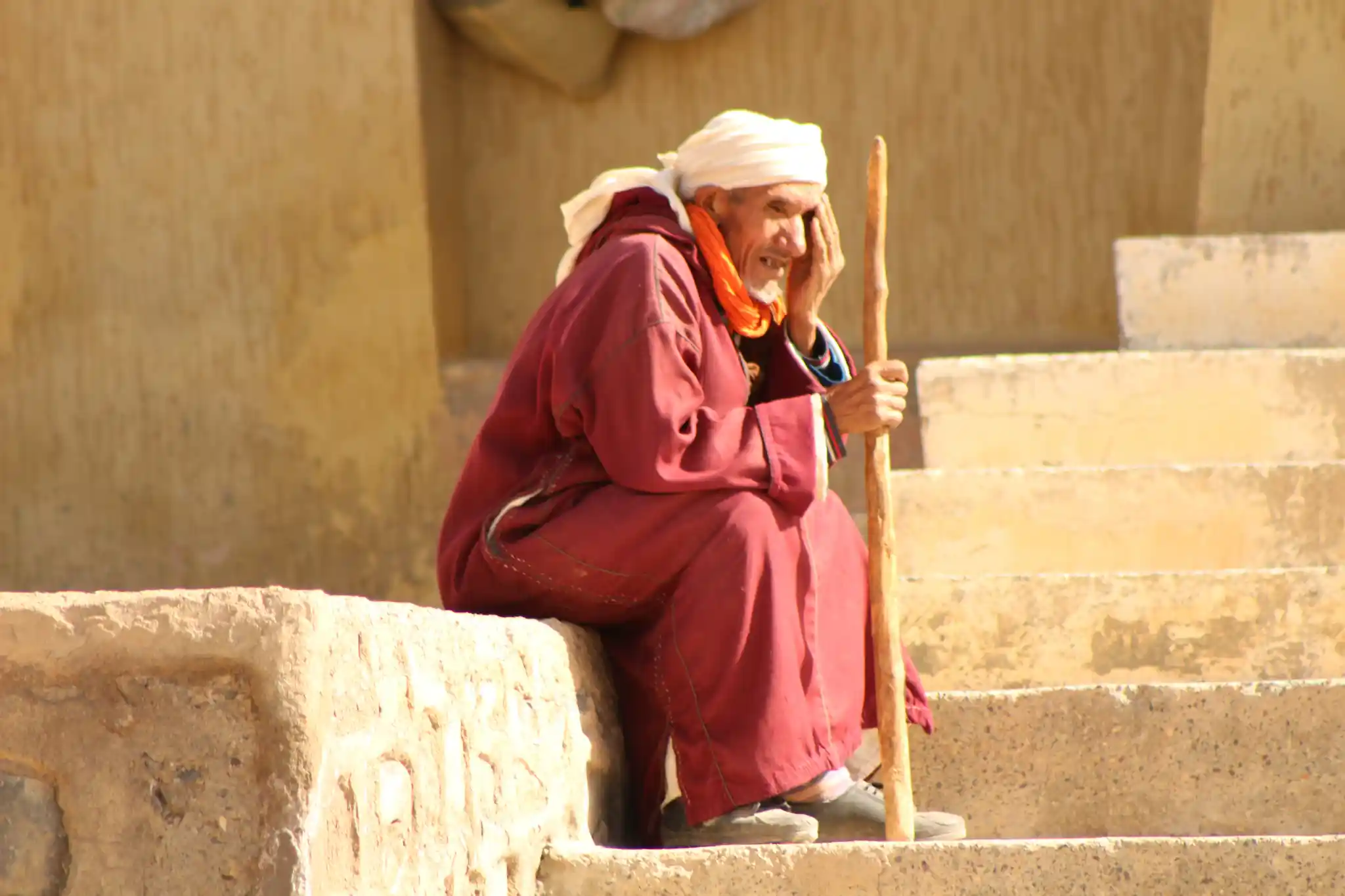
It was then that I noticed him – an elderly man sitting quietly on ancient stone steps. His burgundy jellaba (traditional Moroccan robe) contrasted beautifully with the earthy tones around him, and his wooden cane rested between his hands like the roots of an ancient tree, steadfast despite all storms.
I approached with a traveler’s smile, seeking stories rather than destinations. He returned my gaze with a look that carried more wisdom than words could express. He didn’t speak much, but every wrinkle on his face was like a map of a life fully lived, and the peaceful way he sat was a lesson in contentment.
In a soft voice, he shared: “Those who know the path don’t need to ask about provisions… everything comes in its time.” Then he smiled and turned his gaze back to the horizon.
This brief interaction inspired me to capture the moment artistically, in a watercolor painting that attempts to convey the warmth of the Atlas and the spirit of its people. The colors aren’t just pigments on paper but pulsations of real life, of dignity that still inhabits these mountains.
Throughout my Atlas Mountains journey, I’ve discovered that the most profound lessons often come in the quietest moments. In a world that never stops talking, there’s something powerful about the silence of these ancient peaks.
The mountains themselves seem to whisper stories if you listen closely enough. Each village, each elderly face, each handcrafted item holds centuries of knowledge passed down through generations. This isn’t the kind of wisdom you’ll find in textbooks – it’s lived experience, survival knowledge, and a deep understanding of what truly matters.
The Atlas region is home to Berber communities who have preserved their unique culture despite centuries of change around them. Their hospitality is legendary – if you’re lucky enough to be invited for mint tea (as I was several times during my journey), you’ll experience warmth that makes you feel like family rather than a stranger.
What struck me during my Atlas Mountains journey was how these communities maintain their traditions not as museum pieces but as living practices. Women weave colorful rugs using techniques passed down from mother to daughter for generations. Men still gather in village squares to discuss community matters. Children learn traditional songs alongside their modern schoolwork.
If you’re inspired to embark on your own journey of discovery in the Atlas Mountains, here are some practical tips from my experience:
The Atlas Mountains are beautiful year-round, but each season offers something different:
What makes an Atlas Mountains journey special isn’t just the breathtaking landscapes or the ancient villages – it’s the opportunity for connection and reflection. Here are some ways to create your own meaningful experiences:
While the panoramic views of the Atlas Mountains journey make for beautiful photographs, it’s the everyday moments that reveal the true character of this region. Farmers tending terraced fields that cling impossibly to steep slopes. Women carrying bundles of firewood along ancient paths. Children playing traditional games in village squares.
These mountains aren’t just a pretty backdrop – they’re home to communities facing real challenges. Climate change has brought increasingly unpredictable weather patterns. Young people often leave for economic opportunities in cities. Yet despite these pressures, there’s a resilience here that’s both humbling and inspiring.
That small moment with the elderly man inspired me to create art that captures not just the visual beauty but the emotional essence of the Atlas. My watercolor painting attempts to convey the golden evening light, the texture of the ancient steps, and the dignity in that wise face.
I’m not a professional artist, but sometimes an Atlas Mountains journey moves you to express yourself in new ways. The painting hangs in my home now, a daily reminder of lessons learned in silence.
Months after returning home, I find myself remembering the old man’s words: “Everything comes in its time.” In our rush to see everything, photograph everything, and share everything, we often miss the profound simplicity of being present.
My Atlas Mountains journey taught me to approach travel differently – not as a checklist of sights to see but as an opportunity for transformation. The mountains didn’t just change my understanding of Morocco; they changed how I move through the world.
While hiking is the most popular activity for an Atlas Mountains journey, there are many other ways to experience this remarkable region:
Frequently Asked Questions
Is it safe to travel in the Atlas Mountains?
Yes, the Atlas Mountains are generally very safe for travelers. Crime rates are low, and locals are typically helpful and hospitable. However, as with any remote area, it’s wise to take basic precautions like traveling with a guide in unfamiliar terrain and being prepared for weather changes.
Do I need a guide for hiking in the Atlas?
For major peaks like Toubkal, a guide is required by law. Even for simpler treks, a local guide enhances safety and adds cultural context to your Atlas Mountains journey. They also contribute to the local economy.
What’s the best time of year to visit?
Spring (March-May) and fall (September-November) offer ideal hiking conditions with moderate temperatures. Summer can be hot at lower elevations but pleasant higher up. Winter brings snow to higher areas, making some trails inaccessible without proper equipment.
Can I visit the Atlas Mountains as a day trip from Marrakech?
Yes, the lower foothills are accessible as a day trip (about 1-2 hours’ drive). However, to truly experience the region and have meaningful encounters like the one I described, I recommend spending at least one night in a mountain village.
How physically demanding is trekking in the Atlas?
The Atlas Mountains offer treks for all ability levels. Some gentle walks follow valley floors, while challenging routes ascend peaks over 4,000 meters. Be honest about your fitness level when planning your Atlas Mountains journey.
As I look back on that golden evening in the Atlas, I realize that some travel experiences can’t be planned or purchased – they must simply be allowed to happen. The wisdom I found in that brief encounter continues to unfold in my life, just as the old man predicted: everything in its time.
The Atlas Mountains journey isn’t just about spectacular views or checking off a destination – it’s about opening yourself to the possibility of transformation. It’s about finding wisdom in silence and learning from people whose life experiences are vastly different from your own.
Have you experienced a moment of unexpected connection during your travels? Or are you planning your own adventure to Morocco’s mountains? I’d love to hear your stories in the comments below!
Project Lead and Writer
Hi, I'm Hafid, a passionate traveler and the voice behind Atlas Insiders. Through this blog, I share my journeys, insights, and expert travel tips to inspire and guide fellow adventurers. From hidden gems to cultural deep dives, my goal is to bring you authentic experiences and practical advice to make your travels more enriching. Join me as we explore the world—one destination at a time.
Leave A Comment